


i-frame: Model, Trigger, Automate Your Business Processes
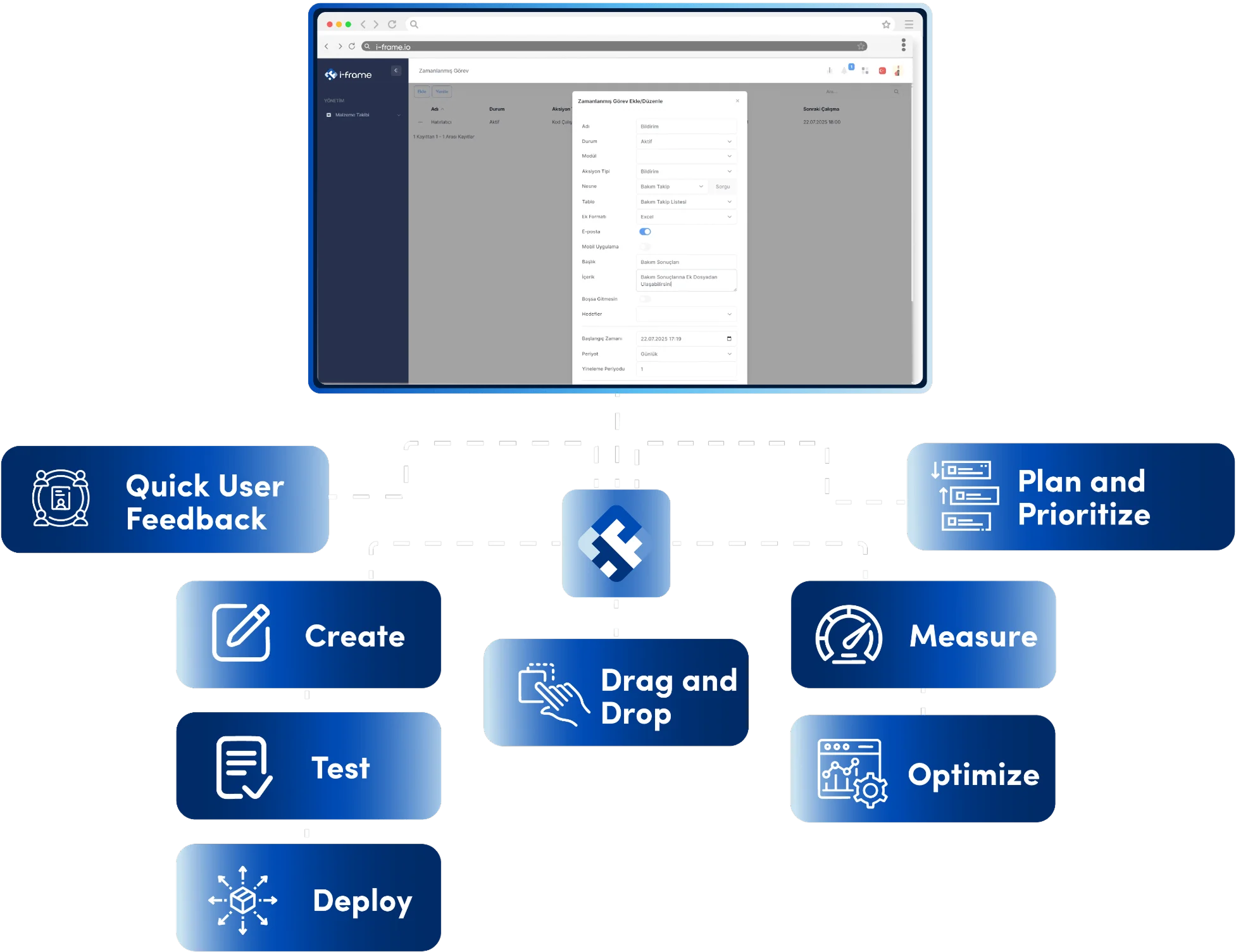
Workflow is the modeling, triggering and automation of business processes in a digital environment.
Operational Efficiency
0
%
Reduction in Human Error
0
%
Source: McKinsey & Company
The Difference Between Traditional Methods and i-frame
Traditional workflow management:
- It was usually done with Excel, email chains or manual forms.
- Processes depended on individuals; they could not be controlled, replicated or sustained.
- Workflow software could usually only be developed by technical teams.
How i-frame Transforms This Process
i-frame, workflows:
- It allows you to design with drag-and-drop tools without the need for technical knowledge.
- It offers components such as authorization, scheduling, automatic notification in an integrated manner.
- It logs every step for corporate memory and makes it traceable.
- Workflow design becomes not an IT activity but a governance process where corporate information is digitized.
Empowering businesses with Workflow solutions
Ease of Use and Integration Capability
| Feature | Traditional Methods | i-frame |
|---|---|---|
| Process Design | Manual drawing or coding | Visual modeling with drag-and-drop interface |
| Access and Authorization | No user-specific control | Role-based, record-based secure authorization |
| Traceability | Limited to email/Excel tracking | All steps are logged, past processes can be reviewed |
| Notification and Automation | Manual reminders | Automated email, SMS, and scheduled task support |
| Integration Capability | Manual intervention requiring API | Real-time data flow with REST API and data objects |
Key Features
Graphics-based workflow editor
Each step can be modeled visually.
Event-trigger system
Processes can be initiated by form filling, timer or user actions.
Scheduled tasks
Automatic triggering for periodic operations.
Notification system
Email/SMS notifications are integrated.
Traceability & Auditability
All transactions are logged and process performance can be analyzed.

Where is i-frame used?
- Request and approval flows (procurement, leave, assignment)
- Human resources processes (recruitment, training, performance)
- Quality processes (audit, non-conformity management)
- Maintenance and service work orders
- Customer complaint and support management
- Archive and document approval mechanisms

Who is using it?
- IT teams Technical experts who ensure the integration of processes into enterprise applications
- Business units such as Quality, HR, Purchasing: Managers who want to digitize their processes and achieve centralized traceability
- Corporate governance structures: Management teams structuring control systems with the goal of internal compliance and sustainability

Advantages of Using i-frame
- Transforming business processes into corporate memory
- Traceable, measurable workflows that strengthen governance
- Automation of repetitive workloads
- Unification of form, approval and process management on a single platform
- Data-driven analysis infrastructure for process improvement
- Sustainable solution bridging business units and IT
