


Integration Power Compatible with All Your Systems with i-frame
Integration refers to making different systems interoperable. This is usually done through APIs, database connections, service calls or messaging protocols.
The Difference Between Traditional Methods and i-frame
Previously, data was exchanged between systems by writing custom code, creating middleware layers and manually converting data formats. This process was time-consuming, error-prone and resulted in high maintenance costs.
How i-frame Transforms This Process ?
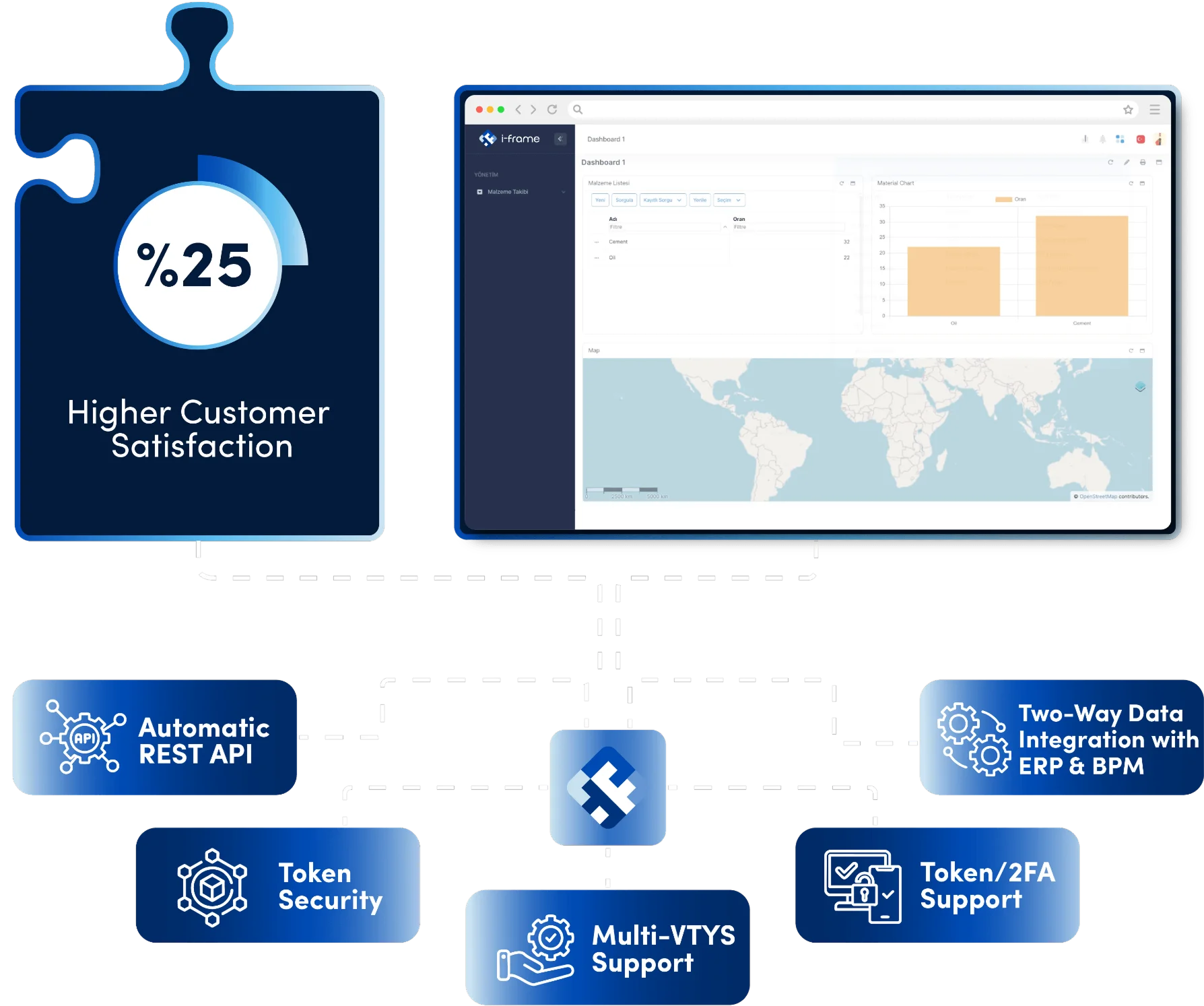
i-frame offers all its functions accessible via REST API. Thanks to the token-based authentication structure:
- Secure data exchange is ensured,
- Easily connected to existing systems,
- Fast integration with external services
Empowering businesses with intelligent AI solutions
Ease of Use and Integration Capability
| Feature | Traditional Methods | i-frame |
|---|---|---|
| API Management | Manual code writing | Automatic REST API definition, token security |
| Database Access | One-way and fixed | Multi-DBMS support, live connections |
| Web Service Usage | Custom integration for each system | Centralized web service integration |
| Security | Manual authorization | Role-based access + token/2FA support |
| GIS / IoT | Integrated with external solutions | Built-in as a direct platform component |
Key Features
Module Access with REST API
All modules are accessed via REST API.
Integrations with external systems can be done in an easy and standardized way.
Secure Integration Infrastructure
Token generation and management supported.
Authorization controlled, secure data flow is possible
Database Connection Management
Compatible with systems such as MSSQL, Oracle, PostgreSQL.
Data management can be done internally by connecting to different data sources.
Reporting with External Data
Reports can be generated from within the application with existing external system data.
Data can be analyzed without being taken into the system.
Web Service Integration
Information from different sources can be combined in a single data structure.
Bidirectional information flow is possible with internal and external services
Dynamic Matching with Geographic Data
Location data can be analyzed and queried on the map.
GIS based vector and raster data can be processed in the system.
Real-time Processing with IoT Device Data
Data received from IoT devices is read instantly by the system.
Data can be integrated into business processes and automatic decision mechanisms can be created.
Where is i-frame used?
- Bi-directional data integration with ERP and BPM systems
- Field data collection through GIS (Geographic Information System)
- Instant data streaming from IoT devices
- Pulling information from web service providers
- Common user management with external applications
Who is using it?
- Enterprise IT teams: Those who want to manage data flow in a centralized and secure structure
- Public institutions: Those who want continuity in projects integrated with different government systems
- OEM manufacturers: Technology companies that want to harmonize their products with other systems

Advantages of Using i-frame
- All integrations can be done at platform level, without the need for separate software development
- Secure, token-based authentication prevents unauthorized access
- Modular structure allows integration to be managed flexibly as the system grows
- Data of internal and external systems become meaningful
- Information management authority is established with a standardized structure